The Ultimate Hall of Fame for Pay-Per-Click Advertising Examples
Discover top pay-per-click advertising examples that boost ROI with proven strategies and creative campaigns.
The Best Pay-Per-Click Advertising Examples (And What Makes Them Work)
The best pay-per-click advertising examples prove one thing: when done right, PPC isn’t just a cost — it’s a growth engine.
Here’s a quick look at standout PPC examples across different formats:
| PPC Ad Type | Real-World Example | Result |
|---|---|---|
| Search Ads | Philly Injury Lawyer targeting high-intent keywords | Lower CPC, higher qualified leads |
| Display Ads | Kleenex geo-targeting flu outbreak regions | 40% year-over-year sales increase |
| Shopping Ads | Google Shopping carousel placements for retailers | 65% of shoppers click the first result |
| Social Ads | Dollar Shave Club video ad campaign | 12,000 orders in 48 hours |
| Remarketing | Vancouver Whitecaps integrated retargeting | $1.18M revenue, 307% ROAS |
| Creative Search | Snickers bidding on 25,381 misspelled keywords | 558,589 impressions in two days |
These aren’t flukes. They’re the result of smart strategy, tight targeting, and a clear understanding of what the audience is searching for.
PPC advertising works on a simple premise: you only pay when someone clicks your ad. No click, no charge. That model gives businesses — big and small — precise control over budget and reach. Search advertising spending has already hit $185.35 billion and is projected to climb to $261 billion by 2028. The opportunity is massive, and the competition is growing fast.
The examples above span industries, budgets, and platforms. But they all share the same DNA: relevance, intent, and a compelling reason to click.
I’m Scott Brazdo, MBA, CEO of Black Tie Digital Marketing, and over my 20+ years leading rebranding and digital growth for companies ranging from emerging startups to nationally recognized brands, I’ve seen which pay-per-click advertising examples drive real revenue — and which ones quietly drain budgets. Let’s break down exactly what separates the winners from the wasted spend.
Understanding the Mechanics of Pay-Per-Click Advertising Examples
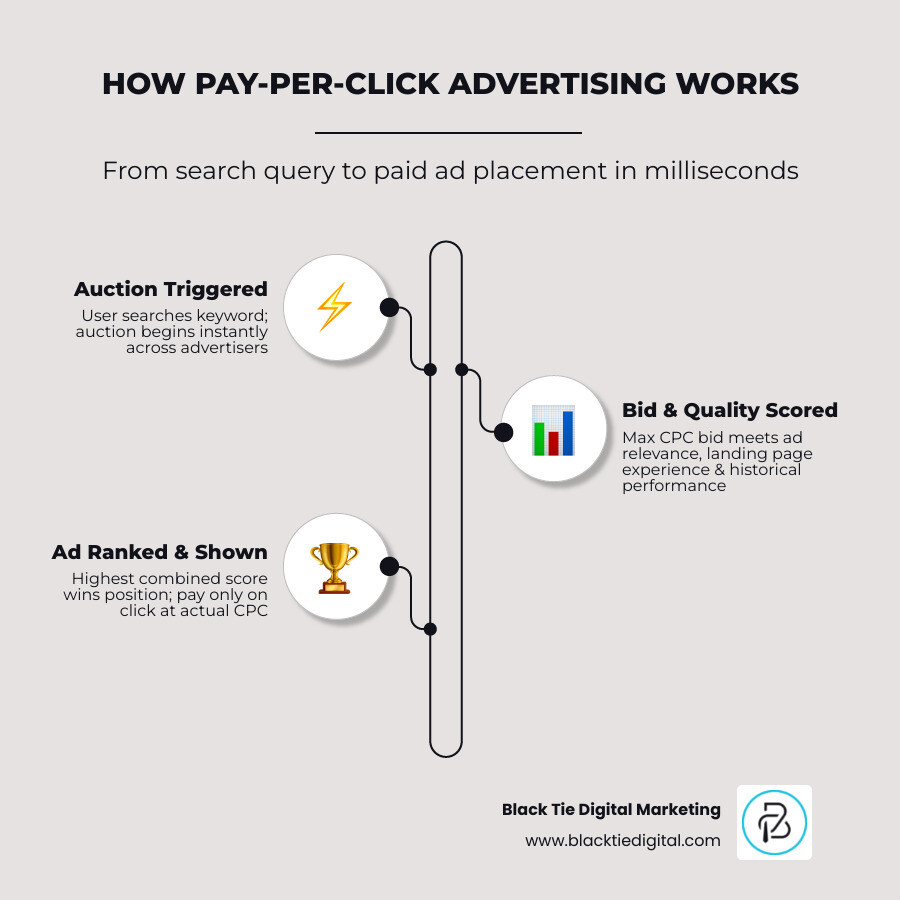
To truly appreciate the pay-per-click advertising examples that make the Hall of Fame, we first have to understand the engine under the hood. PPC is more than just buying a spot at the top of Google; it’s a sophisticated auction that happens in milliseconds every time someone hits “Search.”
The Multi-Channel Landscape
PPC isn’t a monolith. It lives across various platforms and formats:
- Search Ads: These are the text-based ads that appear at the top of search engine results pages (SERPs). They are the bread and butter of PPC Campaigns in Orlando and beyond, capturing users at the exact moment of intent.
- Display Banners: Visual ads that appear on third-party websites. These are excellent for brand awareness and reaching users based on their browsing behavior.
- Shopping Carousels: If you’re a retailer, these are essential. They show a product image, price, and brand name directly in the search results. Statistics show that 65% of shoppers click the first ad on the Google Shopping carousel, regardless of price.
- Social Media Ads: Platforms like Facebook and Instagram allow us to target users based on interests, demographics, and behaviors rather than just search terms.
- Remarketing: This involves showing ads to people who have already visited your site. It’s a powerful way to stay top-of-mind and nudge “window shoppers” toward a purchase.
The Science of the Auction
At Black Tie Digital Marketing, we often say that Black Tie Explains the Science of Paid Search by focusing on the Quality Score. Your position on the page isn’t just determined by who has the biggest wallet. Google uses a formula: Bid Amount x Quality Score = Ad Rank.
Quality Score is a rating of the relevance and quality of your ads and landing pages. This means a smaller business with a highly relevant ad can actually outrank a massive corporation that is bidding more but providing a poor user experience. This “democratic” nature of PPC allows local businesses in Melbourne and Orlando to compete effectively.
How PPC Differs from SEO and SEM
It’s common to hear these terms used interchangeably, but they serve different roles in your marketing strategy.
- SEO (Search Engine Optimization): This is about earning organic rankings over time through content and technical optimization. It’s a long-term play.
- PPC (Pay-Per-Click): This is about buying immediate traffic. You pay for the click, and you get visibility instantly.
- SEM (Search Engine Marketing): This is the umbrella term that covers both SEO and PPC.
While SEO provides a foundation, Paid Search Can Help Marketing Strategy by providing instant data on which keywords actually convert, which can then inform your long-term SEO efforts.
The Role of AI in Modern Pay-Per-Click Advertising Examples
By May 2026, AI has moved from a buzzword to the backbone of high-performing campaigns. We are seeing the rise of Agentic AI, which differs from standard automation. While standard automation follows a “if this, then that” logic, Agentic AI sets its own sub-goals. It can sequence tasks autonomously, identifying that mobile traffic is clicking but not converting, and instantly adjusting bids by -35% without waiting for a human to review the weekly report.
A recent Google Ads Case Study 2026: Almost 2X Sales With Less Ad Spend highlighted how machine learning and Responsive Search Ads (RSAs) can test thousands of headline combinations to find the one that resonates most with a specific user. In one instance, a home gym equipment seller reduced ad spend from $2,620 to $2,170 while nearly doubling sales revenue through AI-driven optimization.
Creative Hall of Fame: Iconic Pay-Per-Click Advertising Examples
Creativity is the “X-factor” that turns a standard ad into a legendary one. Here are some of the most innovative pay-per-click advertising examples in history.
1. Snickers: The “You’re Not You When You’re Hungry” Misspellings
Snickers took a common problem—fat-fingered typing on mobile devices—and turned it into a goldmine. They bid on over 25,000 misspelled versions of common search terms (like “wether” instead of “weather” or “amazin” instead of “amazing”).
- The Hook: The ad copy read: “Grab a Snickers because you can’t spell when you’re hungry.”
- The Result: Over 558,000 impressions in just two days with a click-through rate of 1.05%. By targeting low-competition, misspelled keywords, they reached a massive audience for a fraction of the cost of the correctly spelled terms.
2. Converse: The “Domination” Campaign
Converse decided not to bid on “sneakers” or “shoes.” Instead, they targeted the conversations their target audience was having. They bid on terms like “first day of summer,” “how to kiss,” and even “spelling bee.”
- The Hook: They created engaging microsites that provided cultural value rather than a hard sales pitch.
- The Result: With a budget of just $100,000, they generated 600,000 unique visitors, beating the traditional cost-to-visitor ratio by a staggering 2600%.
3. Kleenex: Predictive Flu-Tracking
Kleenex used Google Trends data to identify regions experiencing a surge in flu symptoms. They then concentrated 96% of their media spend on those specific geographic pockets in real-time.
- The Hook: Reaching people exactly when they needed a tissue most.
- The Result: A 40% year-over-year sales increase in just two months.
4. Dollar Shave Club: The Power of Video
Dollar Shave Club is a masterclass in social PPC. Their humorous, low-budget video ad went viral, but it was the paid distribution that scaled it.
- The Result: 12,000 orders within 48 hours of the ad launch, translating to $144,000 in immediate annual recurring revenue.
5. Alec Brownstein: The $6 Job Interview
In one of the most creative personal pay-per-click advertising examples, a copywriter named Alec Brownstein bid on the names of top creative directors in New York. He knew these directors likely Googled themselves.
- The Hook: When they searched their own names, the top result was an ad from Alec saying, “Googling yourself is a lot of fun. Hiring me is fun, too.”
- The Result: He spent exactly $6, got five interviews, and landed a top-tier job.
High-Performance B2B and Service-Based Pay-Per-Click Advertising Examples
Not every Hall of Fame example is a viral consumer brand. Service-based businesses in Florida use PPC to drive high-value leads every day.
- Real Estate: One investor achieved a 5.3X ROAS (Return on Ad Spend) by focusing on hyper-local geo-targeting. Instead of blanketing the whole state, they targeted specific high-priority counties and used A/B testing to find that landing pages featuring a family photo outperformed stock images by a significant margin.
- Healthcare: A primary care network doubled its conversions while cutting its cost-per-patient by 42%. They achieved this by restructuring their account so each clinic had its own geo-targeted “catchment area” and by using aggressive negative keyword lists to filter out non-patient queries.
- Structural Repairs: A specialist business in the trades sector achieved an 18% conversion rate on their landing page by aligning their ad copy perfectly with service-specific landing pages (e.g., “Underpinning” ads went to an “Underpinning” page, not a general home page).
Optimizing the Post-Click Experience for Maximum ROI
Getting the click is only half the battle. If your ad is a promise, your landing page is the fulfillment of that promise. At Black Tie Digital Marketing, we emphasize that there are Five Things to Know Before Creating an Adwords Campaign, and the post-click experience is at the top of that list.
Landing Page Best Practices
A high-converting landing page isn’t just “pretty.” It’s functional.
- Trust Signals: Place licenses, ratings, and awards in the hero section. For local Orlando or Melbourne businesses, mentioning your local presence builds immediate rapport.
- Clear CTAs: Your Call to Action should be visible at all times. Use “sticky” headers so the “Get a Quote” button follows the user as they scroll.
- Frictionless Forms: Don’t ask for a biography. Ask for the minimum information needed to qualify the lead.
CRM Integration and Lead Nurturing
What happens after the click? This is where many businesses fail. By integrating your PPC campaigns with a CRM (Customer Relationship Management) system, you can track a lead from the initial click to the final sale.
Using tools like Zapier to feed conversion data back into Google Ads allows the AI algorithm to learn which clicks actually turn into money, not just which clicks are cheap. This feedback loop is essential for long-term success.

Frequently Asked Questions about PPC
What is the difference between PPC and CPC?
This is a common point of confusion. PPC (Pay-Per-Click) is the advertising model or the system itself. CPC (Cost-Per-Click) is the metric used to measure what you are actually paying for those clicks. Think of PPC as the car and CPC as the price of the gasoline.
What should I do if my campaign isn’t working?
If you find yourself asking What to Do If Your Adwords Campaign Isn’t Working, start with an audit of your tracking. You can’t fix what you can’t measure. Check your keyword relevance—are you bidding on “broad match” terms that are bringing in junk traffic? Look at your landing page for “friction” (slow load times or confusing layouts). Often, the issue isn’t the ad; it’s the destination.
Why is a low CPC sometimes a bad sign?
It sounds counterintuitive, but PPC Low CPC May Be Costing You. If your cost-per-click is extremely low, you might be winning auctions for low-intent traffic. For example, if you’re a high-end law firm in Orlando, you don’t want the cheapest clicks; you want the right clicks. A higher CPC often indicates a more competitive, high-intent keyword that is more likely to result in a multi-thousand-dollar client.
Conclusion
The world of pay-per-click advertising examples is constantly evolving, shifting from simple keyword bidding to complex, AI-driven strategies that span the entire globe. But whether you are a local business in Melbourne, Florida, or a national brand, the fundamentals remain the same: you must show the right message to the right person at the right time.
At Black Tie Digital Marketing, we don’t just “run ads.” We act as an integrated partner, combining web design, branding, and advanced AI optimization to ensure your marketing dollars aren’t just spent—they’re invested. By bridging the gap between the initial search and the final conversion in your CRM, we help you build a trackable, scalable lead pipeline.
Ready to see your business in the PPC Hall of Fame? Start your journey with expert paid search services and let’s build something that scales.
