

Why Every Empty Chair Is an SEO Problem
SEO for a dental practice is the process of optimizing your online presence so that local patients find you first when they search for a dentist on Google, Google Maps, or AI tools like ChatGPT.
Here is what effective dental SEO covers:
- Google Business Profile – Optimizing your map listing so you appear in the top 3 local results
- Online Reviews – Building review velocity to increase trust and ranking signals
- On-Page SEO – Targeting the right keywords on your service pages and homepage
- Technical SEO – Ensuring your site loads fast and works perfectly on mobile
- Content Authority – Publishing credible content that ranks in Google and gets cited by AI
- Citation Consistency – Keeping your name, address, and phone number identical across all directories
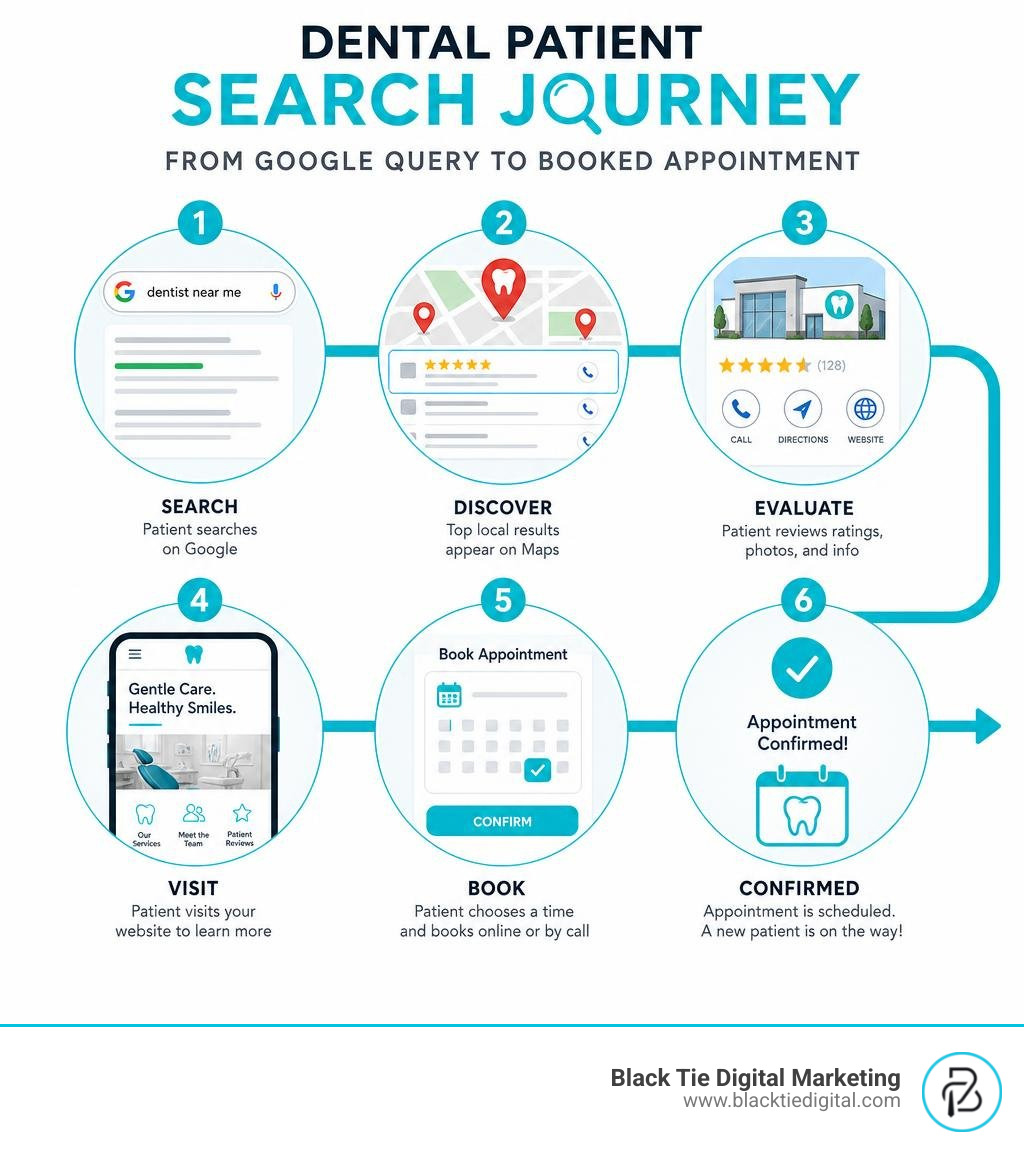
Think about this for a moment. A patient opens Google and types “dentist near me.” Three map listings appear. They glance at the names, the star ratings, and the number of reviews. Then they call one of those three practices.
If your practice is not in those top three spots, that patient never finds you. It does not matter how skilled you are, or how friendly your front desk team is.
This is the reality facing dental practices in 2026. According to recent data, 77% of patients search online before choosing a dentist, and over 68% of clicks on local dental searches go directly to the top three map listings. Word of mouth still matters, but it no longer fills a schedule on its own.
The good news is that the path to those top spots is learnable and repeatable. The six strategies in this guide are the ones that actually move the needle for dental practices.
I’m Scott Brazdo MBA, CEO of Black Tie Digital Marketing, and over more than 20 years of brand strategy and digital marketing experience I have helped hundreds of businesses, including dental practices, build the kind of online presence that consistently drives new patients through SEO for dental practice growth. The strategies in this guide reflect what we have seen work in real, competitive local markets.

The Foundation of SEO for Dental Practice Growth
When we talk about growing a clinic, we are talking about creating a reliable system for patient acquisition. Relying solely on word of mouth or expensive temporary advertising campaigns can leave your schedule with unpredictable gaps. Investing in organic traffic is the most sustainable way to build a healthy practice. It is an investment that builds equity over time, continuing to attract patients long after the initial work is complete.
For a comprehensive overview of how search visibility transforms local businesses, you can explore The Dental SEO Guide. This resource details how winning local search parameters can redefine the growth trajectory of your clinic.


Why You Need SEO for Dental Practice Growth in 2026
The way patients find healthcare providers has shifted fundamentally. In the past, people asked a neighbor or looked in a physical directory. Today, patient search behavior is almost entirely digital. In fact, 77 percent of patients search online before they ever book an appointment.
The dental market is increasingly crowded. In the United States, there are over 60 dentists per 100,000 people, and that number is projected to grow. In competitive local areas across Central Florida, including Orlando and Melbourne, standing out requires more than just hanging a sign outside your office. If you want to understand how to begin this journey, you can read our guide on Marketing Your Dental Practice and Where to Start.
Local Search versus Traditional Search Engine Optimization
Traditional search engine optimization focuses on ranking a website for broad, national keywords. For example, if you write a blog post about the history of dental implants, you might attract readers from across the globe. However, a reader in California cannot visit your clinic in Orlando.
This is why local search is different. It targets patients within a specific geographic radius, usually five to ten miles around your office. Proximity, relevance, and prominence are the key factors here. Because 46 percent of all searches on Google have local intent, geographic targeting is essential. We focus on capturing the patients who are ready to book an appointment today. You can learn more about how we structure these campaigns on our Services: Search Engine Optimization page.
Local Search Secrets: Dominating the Map Pack
The local pack, which is the box of three map listings that appears at the very top of Google search results, is the holy grail of dental marketing. It captures approximately 68 percent of all clicks on local searches. If your clinic is not visible here, you are missing out on the majority of active searchers in your area. To help businesses claim these valuable spots, we offer specialized strategies detailed on our Services: Local Listings page.


Google Business Profile Optimization
Your Google Business Profile is the digital front door of your practice. It is often the very first interaction a patient has with your brand. To optimize it for maximum local search visibility, you must complete every single section with precision.
First, select your primary category carefully. If you are a general dentist, choose Dentist as your primary category. If you specialize in cosmetic procedures, select Cosmetic Dentist. You can add secondary categories, such as Pediatric Dentist or Orthodontist, but your primary category must reflect your main service.
Second, write a business description that highlights your unique services, the geographic areas you serve, and the local landmarks near your office. Avoid generic copy. Instead, speak directly to the dental needs of your community.
Third, upload high quality photos of your office weekly. This includes your waiting room, treatment areas, and your friendly team. Google rewards active profiles, and patients feel more comfortable booking when they can see where they will be treated.
Review Velocity and Reputation Management
Online reviews are a massive ranking factor for local search. They are also the ultimate trust signal for prospective patients. Research shows that 73 percent of patients turn to online reviews as their first step when searching for a provider.
However, simply having a high star rating is not enough. Google also looks at review velocity, which is how frequently you receive new reviews. A practice with 300 reviews from three years ago will often be outranked by a practice with 100 reviews that gets five new ones every week.
To build a consistent flow of feedback, you need a system. This can include verbal requests at checkout or automated text messages sent shortly after an appointment. If you want to dive deeper into why this matters, read our article on Why Are Online Reviews Important?. When managing these reviews, it is also critical to reply to every single one, both positive and negative, in a professional manner. For guidance on how to do this correctly, check out our Best Practices for Responding to Reviews.
Citation Consistency and Local Directories
Citations are mentions of your practice name, address, and phone number across the web. They appear on local directories, healthcare portals, and social media platforms.
Google uses these citations to verify that your business is legitimate and that your contact information is accurate. If one directory lists your address as Suite 100 and another lists it as Room 100, Google may view this as a discrepancy. This inconsistency can lower your trust score and hurt your rankings. Maintaining strict citation hygiene is a foundational step in local SEO. For businesses in our local area, we have created The Local Business Guide to Melbourne FL SEO to help navigate these local directory structures.
On Page and Technical Optimization for Dental Websites
While your Google Business Profile drives a massive amount of traffic, your website is where the actual conversion happens. It is the place where patients research your credentials, read about your services, and book their appointments. Technical SEO ensures that search engines can easily find, crawl, and index your pages. You can find more details on how we optimize these technical elements on our Services: Search Engine Optimization page.
The table below outlines the key technical elements we focus on and how they impact patient conversion.
| Technical Element | Description | Impact on Patient Conversion |
|---|---|---|
| Mobile Optimization | Site adjusts perfectly to all screen sizes | Prevents mobile users from leaving due to bad formatting |
| Site Speed | Pages load in under two seconds | Lowers bounce rates and keeps users engaged |
| Schema Markup | Structured code explaining your business data | Displays rich snippets in search results to improve click rates |
| Secure Connection | HTTPS encryption across the entire site | Builds patient trust and protects sensitive information |
High Impact On Page Strategies
On page optimization is the process of making your website copy and structure highly relevant to both search engines and human readers.
Every service you offer needs its own dedicated page. Do not lump dental implants, teeth whitening, and cleanings onto a single services page. Creating individual pages allows you to target highly specific keywords, such as dental implants in Melbourne Florida.
Each page must have a unique title tag and meta description. Your title tags should lead with the primary keyword and location, followed by your practice name. Header tags should organize your content logically, using H1 for the main title and H2 and H3 for subtopics. To explore more on page tactics, read our post on SEO Tactics You Should Focus On This Year.
Technical Foundations and Schema Markup
Your website must load quickly. If a page takes more than three seconds to load, 40 percent of visitors will leave immediately. This high bounce rate sends a negative signal to Google, which can lower your search rankings.
Additionally, you should implement structured data, specifically dentist schema, into your website code. This is a specialized language that tells search engines exactly who you are, what services you provide, your hours of operation, and your physical location. It acts as a translation layer, making it easy for search engine crawlers to display your information accurately. For a broader look at what makes a digital presence successful, check out our article What Makes a Good Website?.
Multi Location and DSO Strategies
If you operate a multi location practice or a dental service organization, your SEO strategy must adapt. You cannot use a single homepage to rank for five different cities.
Each physical office must have its own unique Google Business Profile. Each location must also have a dedicated landing page on your main website. These location pages need custom content, including the specific address, phone number, local reviews, and directions. Avoid duplicating content across these pages. Instead, write unique descriptions that reflect the distinct community each office serves.
Content Authority and Winning the AI Search Era
Search engine results are evolving. Today, search engines are not just showing a list of links. They are synthesizing answers using artificial intelligence. To remain visible, your practice must build undeniable content authority. If you want to learn how to establish this trust in your local market, read our guide on Building Credibility for Your Local Business.
Creating Content Authority for Patients and Search Engines
Google places a high emphasis on experience, expertise, authoritativeness, and trustworthiness. This is especially true for healthcare websites, which fall under the category of Your Money or Your Life.
To show this expertise, your content should feature clear author credentials. In fact, 73 percent of top ranking health pages now display detailed author bios. Patients want to know who is behind the advice. Before booking, 67 percent of patients verify the dentist’s bio. Make sure your website features professional headshots, detailed bios, and credentials for every provider in your clinic. To build a long term content plan, you can learn How to Create an SEO Strategy that aligns with these trust guidelines.
Optimizing for AI Overviews and ChatGPT
AI search is changing how patients find information. Today, 60 percent of dental searches return an AI generated summary at the top of the search page.
To be cited in these AI Overviews and ChatGPT responses, your content must be structured for easy extraction. AI engines look for direct, concise answers. You can capture these citations by placing a clear answer block at the very top of your service pages. Utilizing FAQ schema is another highly effective way to feed structured questions and answers directly to AI search models.
Measuring Success and Integrating Paid Channels
To know if your search campaign is working, you must track both leading and lagging indicators. Leading indicators, such as organic traffic growth and keyword rankings, show you if you are moving in the right direction. Lagging indicators, such as new patient phone calls and completed booking forms, show you the actual financial return on your investment. If you want to audit your current performance, read our post Is Your SEO Strategy Working?.
For the best results, we recommend integrating your organic efforts with paid channels. While organic search builds long term equity, paid ads can provide immediate visibility for high value treatments.
Step by Step Implementation of SEO for Dental Practice Campaigns
Success in search does not happen overnight. It requires a structured, sequenced approach.
We recommend a 90 day implementation roadmap. During the first 30 days, focus entirely on your technical foundation and auditing your existing assets. Fix slow load times, resolve broken links, and secure your site. During the next 30 days, optimize your Google Business Profile and launch your review acquisition system. In the final 30 days, focus on building high quality content and earning local citations. To understand why this structured approach is so critical, read our article SEO No DIY Project.
Frequently Asked Questions about Dental SEO
Navigating search optimization can bring up many questions for dental professionals. Here are the answers to some of the most common queries we receive.
How long does it take to see results from dental SEO?
SEO is a long term strategy. While you may see initial movement in your local map rankings within six to eight weeks, a complete campaign typically takes six to twelve months to deliver a consistent, predictable flow of new patients. This timeline depends on the competitiveness of your local market and the current health of your website.
Is local SEO or organic SEO more important for dentists?
Both are important, and they work together to build your authority. Local SEO is critical for capturing patients who are looking for immediate care nearby. Organic SEO builds the overall authority of your website, helping you rank for specific treatments and allowing your content to be cited by AI search surfaces.
How do we ask for reviews without violating HIPAA regulations?
To maintain HIPAA compliance, you must never reference a patient’s specific treatment, diagnosis, or clinical relationship in your review requests or responses. Keep your requests generic. Ask patients to share their experience with your customer service or office environment rather than their clinical care.
Conclusion
Building a full schedule requires a digital marketing partner that understands how to connect your clinical expertise with local patients. At Black Tie Digital Marketing, we specialize in helping dental practices stand out in competitive markets like Orlando, Melbourne, and Central Florida.
We do not use generic templates or premade themes. Instead, we specialize in high end WordPress websites built from scratch. This custom website design approach ensures that your site is fast, secure, unique, and fully optimized for search engines and AI tools.
Our team, led by Scott Brazdo, brings a wealth of brand strategy experience to the table. Scott has led major creative and marketing efforts, including the heroic rebrand for KelTec, a premier manufacturer of high quality firearms, and marketing work for B5 Systems, bringing that same level of high caliber strategy to local healthcare providers.
To see how we have helped other clinics grow, you can explore our work with local practices like Case Study: Vero Elite Dentistry, Case Study: Vero VIP Implants & Periodontics, and Case Study: Coral Family Dentistry.
If you are ready to stop worrying about empty chairs and start growing your practice, let us help you build a predictable patient acquisition engine. You can read more about taking your first steps in Marketing Your Dental Practice and Where to Start, or contact us today to begin your custom campaign.