
Why Paid Search Advertising Belongs in Every Growth Strategy
Paid search advertising is one of the fastest ways to get your business in front of people who are actively looking for what you sell — right at the moment they’re searching.
Quick answer: What is paid search advertising?
| Question | Answer |
|---|---|
| What is it? | A digital ad model where you bid on keywords and pay only when someone clicks your ad |
| Where do ads appear? | At the top and bottom of search engine results pages (SERPs), labeled “Sponsored” |
| How is cost determined? | By your bid amount and your Quality Score — not just the highest bidder |
| How fast does it work? | Ads can appear and drive clicks the same day your campaign launches |
| What’s the average ROI? | Businesses average $2 back for every $1 spent on Google Ads |
Here’s why it matters: 65% of all high-intent searches result in an ad click. These aren’t casual browsers — they’re people ready to act. And 46% of all page clicks go to the top three paid results.
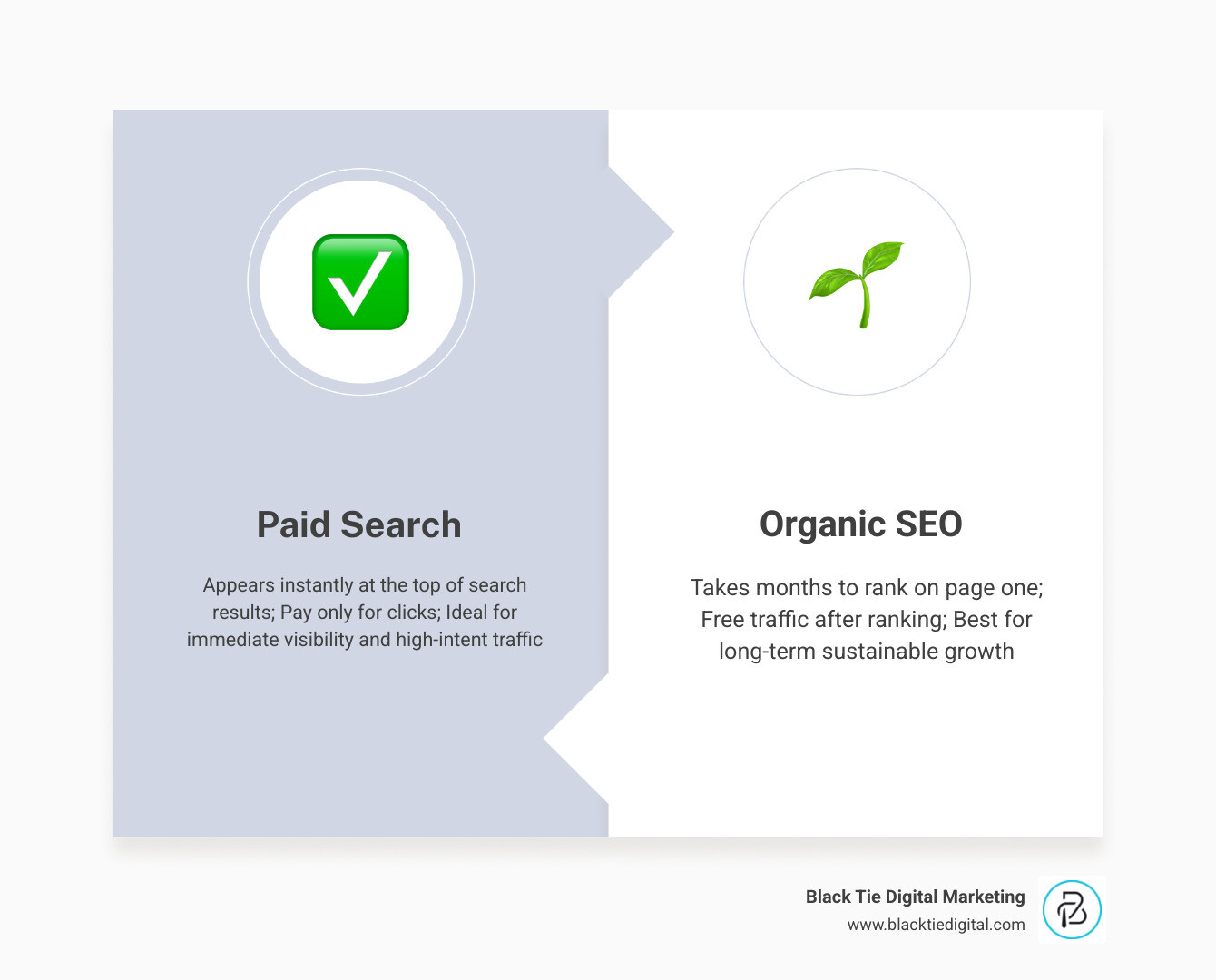
Compare that to organic SEO, which can take months to show results. Paid search puts you on page one today.
That speed and precision is exactly why 96% of advertisers run search campaigns, collectively spending over $351.5 billion globally.
I’m Scott Brazdo, MBA, CEO of Black Tie Digital Marketing — and over my 20+ years leading digital strategy for hundreds of growth-focused companies, paid search advertising has consistently been one of the highest-leverage tools I’ve used to drive measurable revenue for clients. In this guide, I’ll walk you through everything you need to know to run it effectively.

What is Paid Search Advertising?
At its core, paid search advertising is a digital marketing strategy where businesses pay search engines like Google or Bing to place their ads prominently on search engine results pages (SERPs). It is most commonly referred to as Pay-Per-Click (PPC), a model where you aren’t charged for the ad being seen, but only when a user actually clicks on it.
When you search for something on Google, you’ll notice results at the top and bottom of the page marked with a “Sponsored” or “Ad” label. These are the fruits of paid search. These ads occupy the most valuable real estate on the web. Considering that Google alone handles over 3.5 billion searches every day, being at the top of that list is like having a storefront on the busiest street in the world.
While organic SEO focuses on earning a spot through content quality and technical optimization over time, paid search allows you to “cut the line.” This distinction is vital for businesses in Orlando or Melbourne, Florida, looking to make an immediate impact. To dive deeper into how these two worlds interact, check out our Primer: Paid Search Versus Organic Ranking.
The market dominance of this channel is undeniable. Google currently owns over 92% of the global search market share. By utilizing tools like Google Ads, businesses can tap into a massive flow of traffic. It’s also worth noting that over 50% of these ad clicks now happen on mobile devices, making mobile-first ad strategies more important than ever.

The Mechanics of the Paid Search Auction
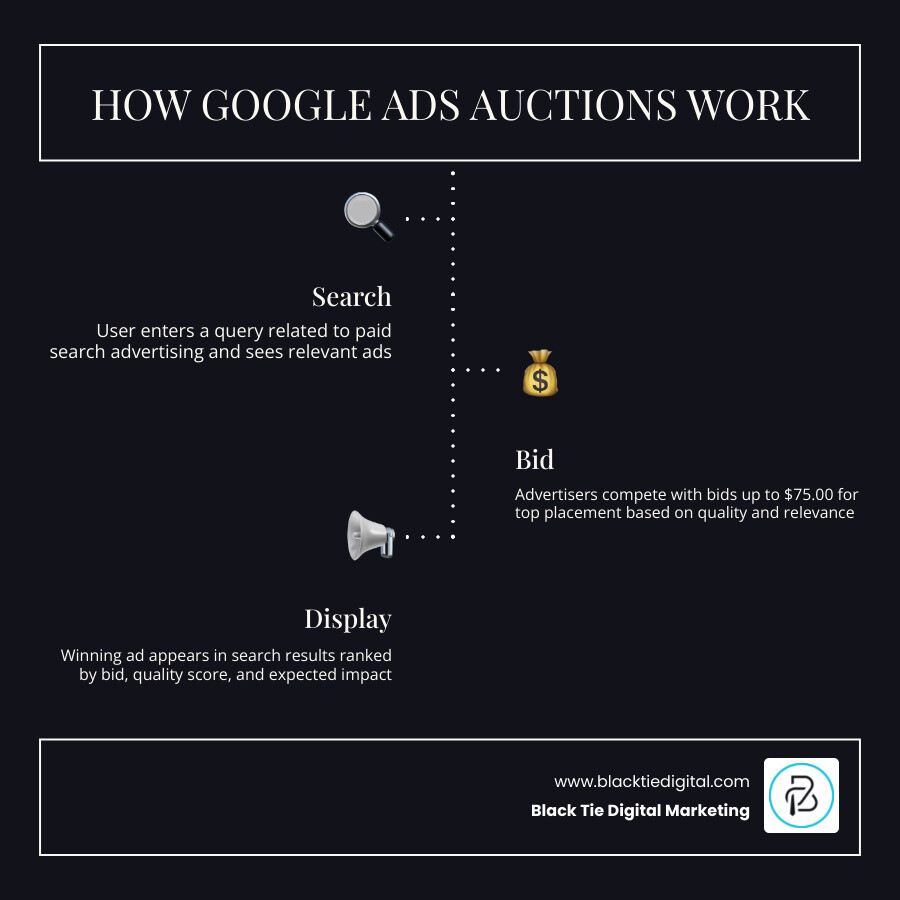
One of the biggest misconceptions about paid search advertising is that the company with the most money always wins the top spot. Thankfully, that’s not how it works. Search engines want to provide a good experience for their users, so they use an “auction” system that rewards quality as much as it rewards a high bid.
Every time a user performs a search, an instantaneous auction takes place. Google determines which ads appear and in what order based on a metric called Ad Rank.
As our team at Black Tie explains in The Science of Paid Search, Ad Rank is calculated using a combination of your Maximum CPC (the most you’re willing to pay for a click) and your Quality Score.
The Quality Score Breakdown
Quality Score is a rating from 1 to 10 that measures the “helpfulness” of your ad. It is based on three main factors:
- Expected Click-Through Rate (CTR): How likely is it that someone will click your ad?
- Ad Relevance: Does your ad copy actually match the searcher’s intent?
- Landing Page Experience: When someone clicks, is the page they land on fast, mobile-friendly, and relevant to what they were looking for?
By maintaining a high Quality Score (usually 7 or above), you can actually pay less than your competitors and still outrank them. You only pay the minimum amount required to beat the Ad Rank of the advertiser directly below you.

Bidding Strategies in Paid Search Advertising
In the early days of AdWords, you had to manually set every bid. Today, we have much more sophisticated options. Understanding which one to use is part of how we Predict the Future of Your AdWords Account.
- Manual Bidding: You have full control over the maximum amount you’ll pay for a click. This is great for new accounts where you’re still gathering data.
- Smart Bidding (AI Optimization): This uses machine learning to optimize for conversions or conversion value in every single auction. Google’s AI analyzes millions of signals—like the user’s location, time of day, and device—to set the perfect bid in real-time.
- Impression Share Bidding: This is used when your goal is brand visibility, ensuring your ad shows up a certain percentage of the time for specific queries.
Key Components of a Successful Campaign
A winning paid search advertising campaign isn’t built on guesswork; it’s built on a foundation of research and structure. Before you even write your first ad, there are five things you need to know regarding your goals and audience.
1. Keyword Research
Keywords are the bridge between what your customer wants and the solution you provide. Using tools like the Google Keyword Planner is essential. If you’re wondering how the Keyword Planner differs from the old Keyword Tool, the modern version provides much deeper insights into search volume and competition levels.
2. Match Types
How strictly do you want Google to match your keywords to a user’s search?
- Broad Match: Reaches the widest audience but can include irrelevant searches.
- Phrase Match: Your ad shows for searches that include the meaning of your keyword.
- Exact Match: Your ad only shows for searches that have the same meaning as your keyword.
3. Negative Keywords
This is one of the most overlooked parts of a campaign. Negative keywords allow you to exclude search terms that aren’t a fit for your business. For example, if you sell “luxury watches,” you might add “free” or “cheap” as negative keywords to avoid wasting money on clicks from people who aren’t your target audience.
4. High-Converting Landing Pages
Your ad is a promise; your landing page is the fulfillment of that promise. If your ad talks about “Emergency Plumbing in Orlando,” but the link goes to your homepage about general construction, the user will leave. A high-converting landing page must be fast, have a clear call-to-action (CTA), and be perfectly aligned with the ad copy.
Crafting Effective Paid Search Advertising Copy
Writing ad copy is an art form. You have limited space to grab attention and convince someone to click. The industry standard today is the Responsive Search Ad (RSA).
With RSAs, you provide up to 15 headlines and 4 descriptions. Google’s AI then tests different combinations to see which ones perform best for different users. This allows you to reach more customers by tailoring the message to the specific search query.
Best Practices for Ad Copy:
- Include Keywords: Put your primary keyword in at least one headline.
- Focus on Benefits: Don’t just say what you do; say how you help. Instead of “24/7 Plumber,” try “Fix Your Leak Today.”
- Strong Call to Action: Tell them exactly what to do next—”Get a Quote,” “Shop Now,” or “Call Today.”
- Use Ad Assets: These were formerly called “extensions.” They allow you to add sitelinks (links to other pages), callouts (like “Free Shipping”), and phone numbers to your ad, making it larger and more helpful.
Measuring Success and ROI
The beauty of paid search advertising is that every penny is trackable. Unlike a billboard on I-4, we know exactly how many people saw your ad, clicked it, and eventually became a customer.
To know if your campaign is working, you need to look at the right metrics. If things seem off, don’t panic—there are clear steps for what to do if your campaign isn’t working.
Key Performance Indicators (KPIs)
| Metric | What it Tells You | Why it Matters |
|---|---|---|
| CTR (Click-Through Rate) | Percentage of people who saw the ad and clicked | Measures how compelling your ad is. |
| CPC (Cost Per Click) | The average amount you pay for each click | Helps you manage your budget and efficiency. |
| CPA (Cost Per Acquisition) | How much it costs to get one lead or sale | The ultimate measure of profitability. |
| ROAS (Return on Ad Spend) | Revenue generated for every $1 spent | Tells you the direct financial impact of your ads. |
The Power of Data
Conversion tracking is non-negotiable. By placing a small piece of code on your “Thank You” or “Order Confirmation” page, you can tie revenue directly back to the specific keyword that started the journey. This allows us to double down on what’s working and cut what isn’t. Brands see an average return of $8 for every dollar they spend advertising on Google when their campaigns are properly optimized.
Frequently Asked Questions about Paid Search
How does paid search differ from organic SEO?
Think of SEO as buying a house and paid search as renting an apartment. With SEO, you build equity over time and eventually “own” the traffic without paying for every click. With paid search, you get immediate access to the best neighborhood (the top of page one), but the traffic stops once you stop paying. The most successful strategies use both to create a balanced marketing ecosystem.
How much does paid search advertising cost for small businesses?
The “cost” is entirely up to you. You set a daily budget that you are comfortable with. In competitive industries like law or insurance, clicks can be expensive, but for many local businesses in Central Florida, you can see significant results with a modest starting budget. Businesses make an average of $2 for every $1 they spend on Google Ads.
How long does it take to see results from a new campaign?
You can see impressions and clicks within minutes of your ads being approved (which usually takes less than one business day). However, it typically takes 2 to 4 weeks to gather enough data for the AI to fully optimize your bidding and for you to see a stable Return on Investment.
Conclusion
Paid search advertising is no longer just an “extra” part of a marketing plan; for businesses in Orlando and Melbourne, it is often the engine that drives growth. It provides the immediate visibility, high-intent traffic, and measurable ROI that traditional advertising simply cannot match.
At Black Tie Digital Marketing, we specialize in taking the complexity out of these systems. By combining the power of AI-powered optimization with a deep understanding of the Central Florida market, we help our clients turn searchers into customers. Whether you are looking to help your overall marketing strategy or you’re ready to launch your first campaign, we’re here to help.
The digital landscape of 2026 moves fast. Don’t let your competitors own the top of the search page.