Everything You Need to Know About Branding Strategy Fundamentals
Learn the fundamentals of branding and consumer brand strategy to build equity, boost retention, and drive sustainable business growth.
By Scott Brazdo
Why Branding and Consumer Brand Strategy Drive Growth
Branding and consumer brand strategy is the long term plan for how customers recognize, understand, trust, and choose a business. It connects a clear purpose, focused market position, consistent message, and customer experience so your brand earns preference beyond a single campaign or product.
A strong consumer brand helps people quickly answer three questions:
- What does this company stand for?
- Why is it different from the alternatives?
- Why should I trust it with my money and attention?
That clarity matters. Consistent brand presentation across channels is linked to higher revenue, while strong brands can lower customer acquisition costs and support stronger pricing power over time. In a crowded market, a polished logo alone is not enough. Your website, messaging, service, products, and marketing must all reinforce the same promise.
For growth focused companies, Black Tie Digital Marketing brings that strategy to life through branding, digital marketing, and custom website design. We specialize in high end WordPress websites built from scratch, with no templates or premade themes, so the online experience reflects the distinct value of the brand behind it.
I am Scott Brazdo MBA, CEO of Black Tie Digital Marketing, an honest faith based digital marketing agency with more than 20 years of experience in branding and consumer brand strategy. I have led the rebranding of more than 500 companies, helping growth focused businesses clarify their message, strengthen their identity, and build brands designed to perform across every medium.
Branding and consumer brand strategy helpful reading:
What Is Consumer Branding and Why Does It Matter for Business Growth?
Consumer branding is the strategic art and science of shaping how buyers perceive your company, products, and services. It moves your business beyond competing purely on price or technical specifications. When you build strong brand equity, your business creates an intangible commercial asset that drives tangible enterprise value. Studies reveal that on average, brand equity accounts for more than a third of total shareholder value. For a neutral overview of this concept, see this background resource on brand equity.

The economic benefits of a disciplined consumer brand strategy touch every corner of your income statement:
- Lower Customer Acquisition Costs: Strong brands enjoy twenty to forty percent lower customer acquisition costs over time because familiar brands enjoy higher click through rates and direct organic search volume.
- Pricing Power: Brands sitting in the top quartile of market awareness can charge roughly thirteen percent price premiums over generic competitors.
- Shorter Sales Cycles: Known brands close sales deals twenty four percent faster because buyer friction and perceived risk disappear.
- Market Resilience: Brands with above average consumer awareness hold revenue during economic downturns twice as well as weaker brands. Investing in brand equity during recessions can lead to four point five times greater market share gains when market growth returns.
When a brand earns consumer trust, customers do not re evaluate their purchase decision every single time they need a solution. They default to the name they know and respect.
Understanding Branding and Consumer Brand Strategy
At its heart, branding and consumer brand strategy aligns your internal purpose with external market expectations. Modern buyers do not buy just what you make, they care deeply about why you make it and how you operate. Research shows that seventy nine percent of consumers prefer buying from brands whose values reflect their own personal beliefs.
When implementing comprehensive brand strategy frameworks through Black Tie Digital Marketing, modern brand strategy operates across an entire ecosystem. A successful brand strategy anchors your messaging, visual assets, digital presence, and customer support around a single authentic core.
Understanding your internal identity is the required first step. If you want to dive deeper into this foundational work, read our full breakdown on Knowing Your Brand.
Consumer Branding vs. Employer Branding
While consumer branding speaks to buyers to drive market share and sales, employer branding speaks to current and potential talent to drive recruitment and retention. Both strategies pull from the same organizational mission, but they apply different tones and channels.
- Consumer Branding: Focuses on target buyers, customer pain points, product benefits, and brand trust. Channels include digital marketing campaigns, packaging, search engines, and social media.
- Employer Branding: Focuses on job candidates, workplace culture, professional growth, and employee values. Channels include career pages, professional networking channels, and internal team communications.
These two disciplines strengthen each other. Companies with strong employer brands see twenty eight percent lower employee turnover. Happy, engaged employees deliver superior customer service, which directly strengthens your consumer brand. As we highlight in our guide on how Developing a Brand Is the First Step to a Great Business, internal culture and external brand perception are two sides of the same coin.
Core Elements of Branding and Consumer Brand Strategy

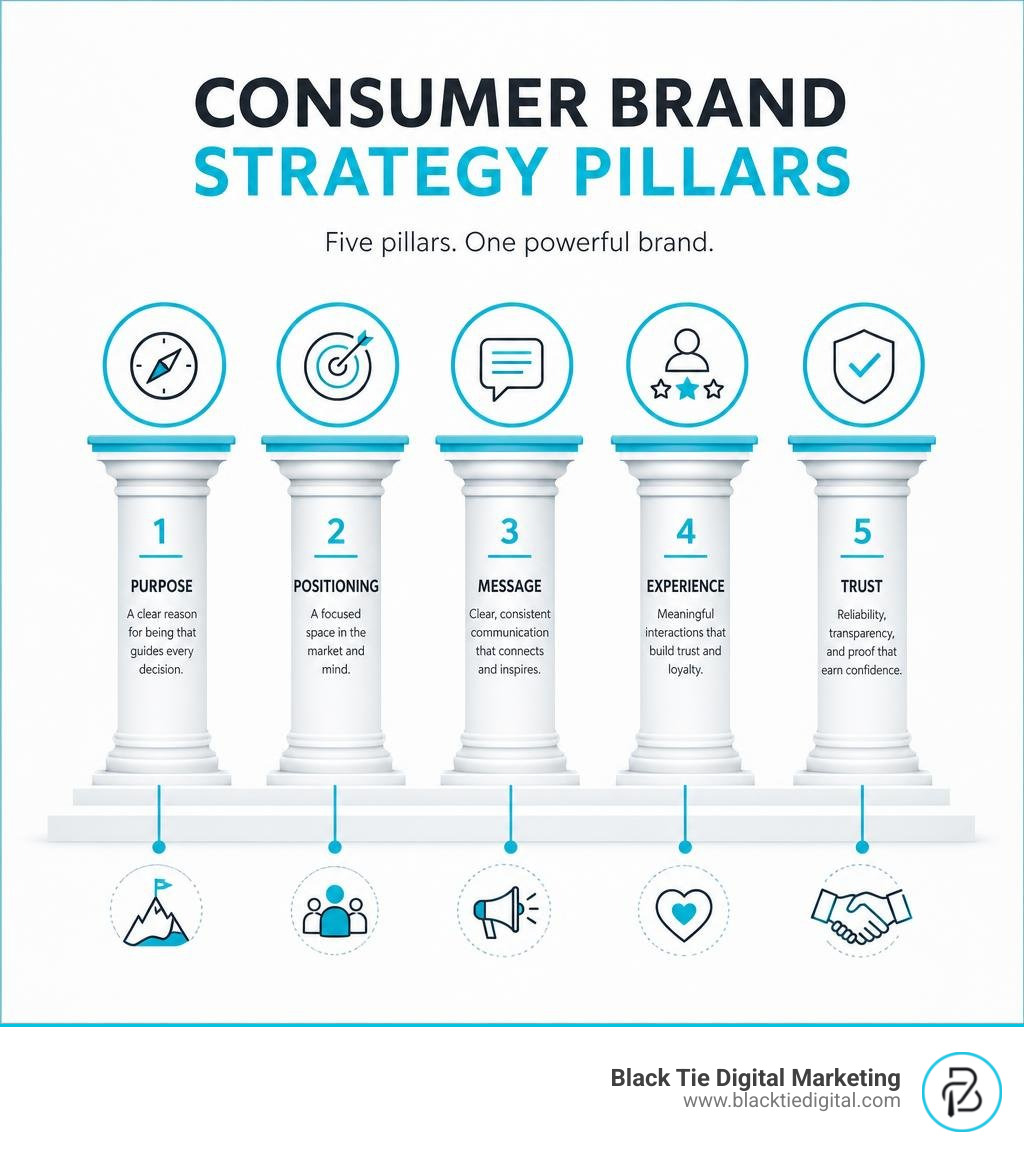
A comprehensive consumer brand strategy relies on five connected pillars that give your organization direction and focus:
- Brand Purpose: The core reason your company exists beyond making profit.
- Brand Positioning: The distinct space you occupy in the consumer mind relative to market alternatives.
- Brand Personality: The human character traits and tone of voice your brand projects across touchpoints.
- Brand Promise: The explicit commitment you make regarding product performance, service speed, or customer outcome.
- Brand Perception: The actual emotional and cognitive impression consumers hold about your company.
To organize these elements effectively, modern organizations rely on structured frameworks. Black Tie Digital Marketing delivers custom strategic models and brand frameworks to keep executive teams and creative groups aligned during brand development.
Execution Steps for Branding and Consumer Brand Strategy
Building a resilient brand requires a step by step approach anchored in hard market data rather than subjective opinions.
- Research Target Personas: Uncover exact customer demographics, emotional triggers, buying barriers, and daily challenges.
- Analyze Competitive Gaps: Study competitors to find unserved consumer expectations and market white space.
- Draft a Positioning Statement: Use a proven structure (For target audience, your brand is the category leader that provides key benefit because of specific proof points). If you run a technology business, discover Why Your Tech Company Needs a Positioning Statement.
- Establish Messaging Hierarchies: Define core brand taglines, secondary supporting points, and persona specific value messages.
- Develop Visual Guidelines: Establish strict standards for logo usage, color palettes, typography, imagery style, and UI elements.
Differentiating Brand Strategy, Marketing Strategy, and Brand Identity
Many business owners blur the lines between brand strategy, marketing strategy, and brand identity. Clarifying these differences prevents wasted budget and strategic misalignment.
- Brand Strategy: Defines who you are, why you exist, and how you are positioned over a five to ten year planning horizon. Key deliverables include purpose, values, positioning, and personality traits.
- Marketing Strategy: Outlines how you will achieve immediate commercial targets over a twelve to twenty four month planning horizon. Key deliverables include campaign plans, media spend, sales funnels, and promotional offer design.
- Brand Identity: Represents the visual and sensory translation of the strategy over a three to five year planning horizon. Key deliverables include logos, typography, color palettes, and packaging design.
A high quality visual identity without a solid brand strategy is just pretty artwork. Conversely, a great brand strategy without consistent marketing execution remains invisible. You can learn more about balancing functional messaging and visual experiences in our article on Branding and Experiential Branding: What’s the Real Difference?.
For revenue driven growth, Black Tie Digital Marketing partners with leadership teams to design tailored brand positioning that translates strategic clarity into sustainable enterprise value.
How to Build, Execute, and Measure a Strong Consumer Brand
Executing a consumer brand strategy requires total consistency across every channel. When a customer sees your digital advertisement, browses your website, reads product documentation, or speaks with customer support, the experience should feel unified.
Inconsistent branding creates friction and doubt. Companies that maintain a consistent brand presentation across channels enjoy an average of twenty three percent higher revenue compared to companies with disjointed communications. To maintain high standards across digital channels, follow our framework in The Omnichannel Branding Guide: Creating a Seamless Customer Experience.
B2B vs. B2C Contexts in Brand Strategy
While foundational principles like purpose and positioning apply across all business models, executing branding and consumer brand strategy differs between business to consumer (B2C) and business to business (B2B) markets.
- B2C Context: Consumer buying decisions are heavily driven by emotional connection, lifestyle alignment, price points, and personal preference. Buying cycles are often short, ranging from seconds to days. Visual identity and storytelling play an enormous immediate role.
- B2B Context: Business decisions involve higher dollar values, multiple stakeholders, formal evaluation criteria, and lingering career risk for buyers. The sales cycle often spans months. Here, brand trust serves as a primary risk reducer across twenty seven or more touchpoints.
Whether selling direct to consumers or serving corporate buying committees, managing perception is critical. Read more on how buyers form opinions in our piece, Brand Perception Is Everything.
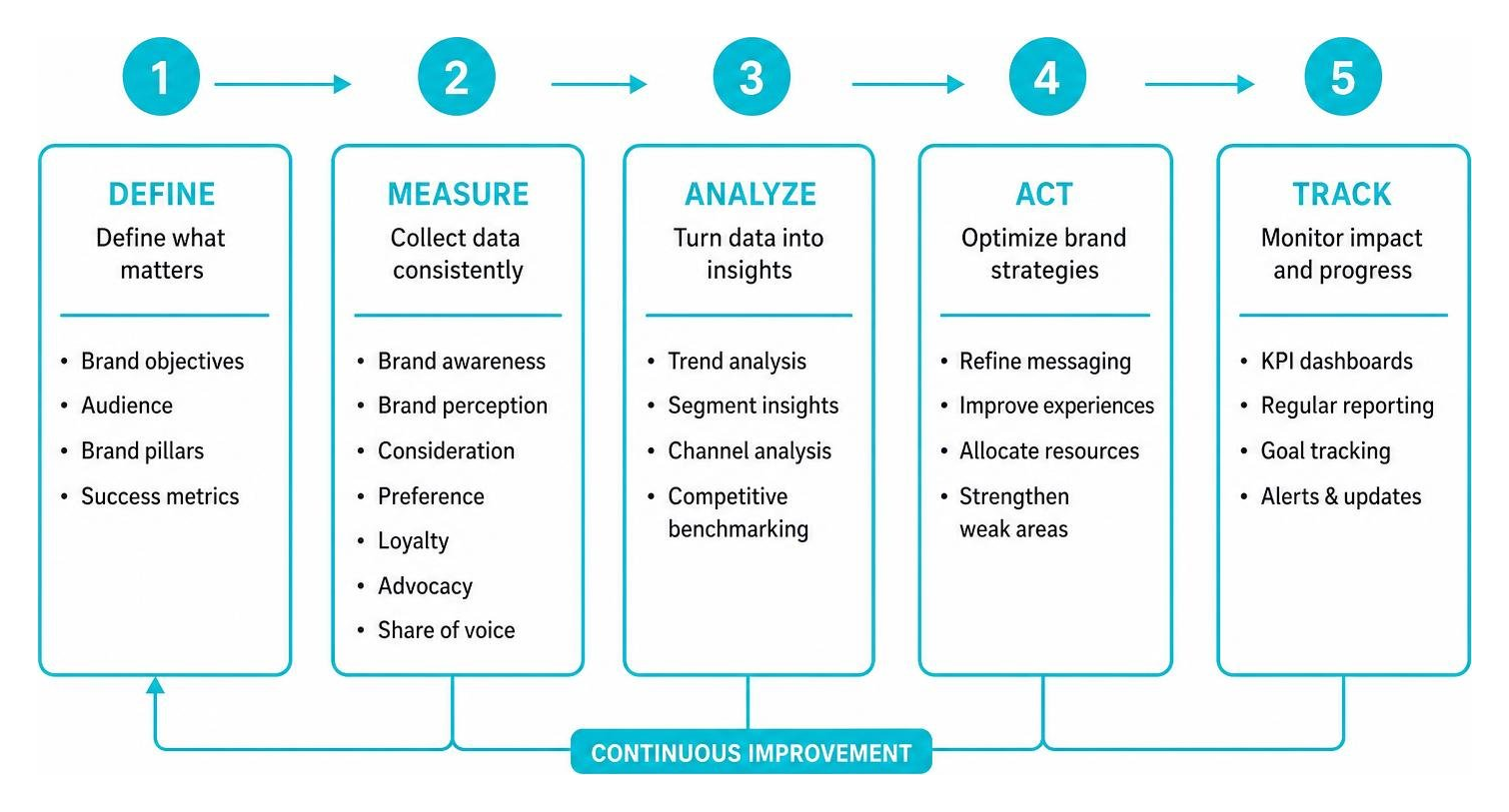
Measuring Strategic Brand Equity and ROI Metrics
Tracking brand strategy performance requires balancing short term leading metrics with long term lagging business outcomes.
- Leading Brand Indicators: Direct website traffic, organic branded search volume, social media brand sentiment, and brand recall scores.
- Lagging Commercial Metrics: Customer acquisition cost trends, win rates against category competitors, pricing power metrics, customer retention rates, and customer lifetime value.
Evaluating these metrics annually provides clear feedback on whether your market positioning is resonating or if strategic adjustments are required.
Frequently Asked Questions About Consumer Branding
What is the main difference between brand strategy and marketing strategy?
Brand strategy defines the long term identity, core values, target audience positioning, and fundamental promise of your company over a five to ten year horizon. Marketing strategy defines the specific campaigns, advertising channels, budget allocations, and sales promotions used to achieve short term commercial goals over a twelve to twenty four month horizon. Brand strategy provides the guardrails within which marketing strategy operates.
How long does it take to establish a consumer brand strategy?
Developing a comprehensive brand strategy typically takes six to twelve weeks of discovery, audience research, positioning development, and visual identity design. However, establishing that brand position firmly in the minds of prospective buyers requires twelve to twenty four months of disciplined, consistent execution across marketing channels, digital assets, and customer experiences.
What are the most common mistakes to avoid in brand strategy?
The most frequent brand strategy mistakes include:
- Trying to appeal to everyone instead of taking a distinct position for a specific audience.
- Treating brand strategy as purely a logo or graphic design exercise without commercial substance.
- Changing brand messaging too quickly before market awareness can compound.
- Allowing inconsistency between external brand promises and internal service delivery.
- Failing to measure leading brand health metrics over time.
Conclusion: Building Your Sustainable Advantage with Strategic Branding

A well crafted branding and consumer brand strategy is one of the most powerful competitive advantages a business can build. It lowers your acquisition costs, protects your profit margins during tough economic times, accelerates sales cycles, and earns lasting customer preference in crowded markets.
Building an exceptional consumer brand requires aligning your strategy with a digital presence that reflects your standards. At Black Tie Digital Marketing, we act as an innovative partner for growth focused businesses across Central Florida, including Orlando and Melbourne, Florida. We combine the power of ten traditional vendors into one dedicated partner, providing comprehensive branding, digital marketing, search engine optimization, and custom web development.
When it comes to your web presence, we specialize in high end WordPress websites built from scratch, with absolutely no templates or premade themes. This custom approach is a unique agency quality that ensures your online footprint is as distinct and strategically aligned as your business.
We bring proven, multi industry experience to every project, partnering with industry leaders who defend essential freedom and advance market innovation. Scott Brazdo led the rebrand for KelTec, positioning their brand for long term market leadership, and led marketing work for B5 Systems. As an honest faith based digital marketing agency, we bring integrity, strategic depth, and high execution standards to every client partnership.
Are you ready to strengthen your positioning and build a brand that drives long term business growth? Explore our dedicated Branding Services today, and let us build a brand strategy that sets your company apart.